Ksubi: The Australian Denim Brand That Rewrote the Rules
Origins: Sydney, 1999
Ksubi was founded in 1999 in Sydney, Australia, by Dan Single, George Gorrow, Paul Wilson, and Oliver Stuart — a group of friends who met through Sydney's late-1990s fashion, music, and nightlife scenes. Originally launched under the name Tsubi (later changed to Ksubi in 2007 after a trademark dispute), the brand emerged as part of a generation of Australian labels reimagining denim through a punk, music-driven, anti-establishment lens.
The founders made an early statement that defined the brand's irreverent ethos: their debut runway show at Australian Fashion Week 2000 featured 1,000 live rats released onto the catwalk. The stunt drew international press, regulatory backlash, and a permanent place in Australian fashion folklore — establishing Ksubi from day one as a brand more interested in cultural provocation than industry approval.
A quarter-century later, Ksubi has evolved from a scrappy Sydney denim project into a globally recognized streetwear and denim brand, worn by Travis Scott, Kendall Jenner, Bella Hadid, Playboi Carti, and a generation of consumers drawn to its rebellious aesthetic and uncompromising fit.
Brand Philosophy and Design DNA
Ksubi's identity is rooted in a specific cultural attitude: denim as a vehicle for self-expression, subversion, and music subculture references — closer in spirit to 1970s rock'n'roll and 1990s grunge than to the heritage workwear narratives that dominate American denim.
Core design signatures include:
-
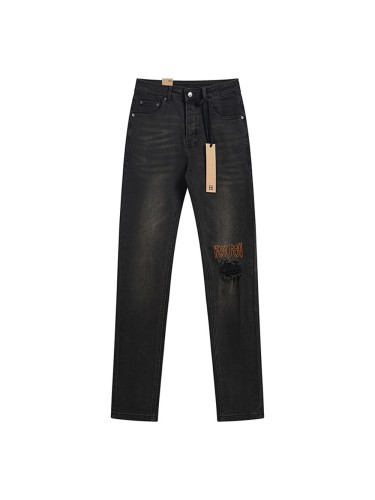
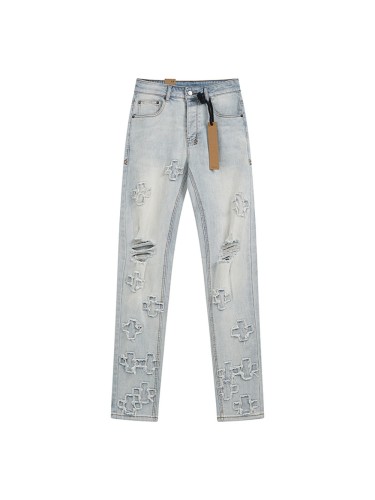
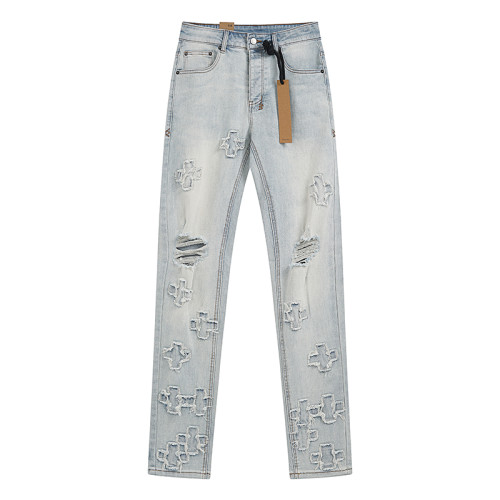
Distressed, deconstructed denim — heavy whiskering, blowouts, paint splatters, raw hems, and intentional imperfection treated as design rather than damage
-
Skinny and slim silhouettes, balanced in recent years by an expanding range of relaxed, baggy, and wide-leg cuts reflecting current denim trends
-
The signature "Ksubi" wordmark — applied as embroidery, prints, and hardware across denim, knitwear, and accessories
-
Rock'n'roll and rave culture references — graphic tees, washed-out band tee aesthetics, religious and occult iconography, and a recurring fascination with rebellion, decay, and youth subculture
-
Bold graphic experimentation — the "Kult Eye" and "Sign of the Times" motifs have become recognizable symbols within the streetwear community
The brand operates on a clear creative principle: denim is not heritage, it's attitude. Where American denim brands lean on workwear authenticity and Japanese brands lean on craft obsession, Ksubi leans on music, nightlife, and youth rebellion — a position that has proven remarkably durable across multiple aesthetic cycles.
Brand Evolution and Ownership
Ksubi's path has been more turbulent than most fashion brands of its era — a reality that has shaped both its mythology and its product.
Early independent years (1999–2009). The founding team built Ksubi into one of Australia's most influential brands, expanding internationally and earning cult status in the UK, Japan, and the United States. The Tsubi-to-Ksubi rename in 2007 marked a global rebrand and a push into more ambitious markets.
Financial collapse (2009). Despite cultural success, Ksubi entered voluntary administration in 2009, a casualty of the global financial crisis and aggressive expansion. The original founders departed in stages over the following years.
General Pants Group acquisition (2010). Australian retailer General Pants Group acquired the brand and stabilized operations, repositioning Ksubi for a new generation while retaining its rebellious DNA.
Resurgence (2017–present). A creative reset under designer Craig King repositioned Ksubi for the streetwear era, with new graphics, expanded categories, and a sharper focus on cultural relevance. Strategic celebrity adoption — particularly by Travis Scott, who has worn Ksubi extensively across tours, music videos, and red carpets — accelerated the brand's resurgence in the U.S. and global markets.
Brand Strategy: Music as the Marketing Engine
Ksubi has consistently treated music culture as the brand's primary distribution channel — more important than traditional advertising, more durable than fashion week presence.
1. Organic celebrity alignment. Travis Scott, Playboi Carti, Future, Bella Hadid, Hailey Bieber, and dozens of other artists wear Ksubi without traditional endorsement structures. The brand's denim and graphic tees have become near-uniform within certain hip-hop and pop adjacent scenes.
2. Music-led collaborations. Capsule projects with artists, music festivals, and tour merch crossover have kept the brand embedded in live music culture across multiple genres.
3. Selective fashion industry engagement. Unlike many peers, Ksubi has stayed largely outside the traditional fashion week circuit, focusing instead on direct-to-consumer storytelling, lookbooks, and cultural moments.
4. Strategic flagship retail. Stores in New York (SoHo), Los Angeles, London, Sydney, and Melbourne function as immersive cultural spaces rather than conventional retail — designed to feel closer to record stores or galleries than to fashion boutiques.
5. Wholesale through cultural gatekeepers. Distribution through SSENSE, END., Mr Porter, Selfridges, and Saks positions the brand within the same retail ecosystem as Acne Studios, Off-White, and Rick Owens — adjacent to luxury without claiming the price points.
Market Position and Trends
Pricing. Ksubi denim retails between $250 and $450, graphic tees between $80 and $150, outerwear between $400 and $1,200. The brand sits in the premium denim and elevated streetwear tier — competitive with AGOLDE, Acne Studios, and Amiri at the lower end, though at meaningfully lower prices than Amiri or Saint Laurent on most categories.
The denim renaissance. After years of athleisure and sweatpant dominance, denim has reentered the cultural conversation with force. Wide-leg, baggy, and Y2K-influenced silhouettes have driven a broad denim revival, and Ksubi's Van Winkle and Chitch fits — alongside newer relaxed cuts — have positioned the brand to benefit directly from this shift.
Y2K and indie sleaze nostalgia. The cultural return of mid-2000s and early-2010s aesthetics — skinny jeans, distressed denim, music-festival imagery — aligns naturally with Ksubi's heritage. The brand is one of the few that lived through the original era and can claim authentic continuity rather than retrospective imitation.
Streetwear's recalibration. As the broader streetwear market has cooled from its 2017–2021 peak, brands rooted in genuine subculture rather than pure hype have proven more resilient. Ksubi's music and nightlife credibility has made it a beneficiary of this shift.
Cultural Legacy
Ksubi's most significant contribution may be proving that Australia could produce a globally relevant fashion brand on its own creative terms — without copying European luxury codes, American workwear traditions, or Japanese craft narratives. Alongside brands like Zimmermann, Camilla and Marc, and Aje, Ksubi helped legitimize Australian fashion as a category with its own voice.
More specifically, Ksubi played a meaningful role in shaping the global skinny denim era of the mid-2000s and early 2010s — a silhouette that, for better or worse, defined a generation of menswear and influenced everything from Hedi Slimane's Saint Laurent to mass-market high street denim.
The brand also demonstrated something that has since become conventional wisdom: that music culture, not fashion week, is often the most powerful marketing channel for youth-oriented brands. Long before social media-era brands built their entire identity around artist relationships, Ksubi was already operating on this principle.
Looking Ahead
Ksubi's challenge in the late 2020s is the classic challenge facing any 25-year-old brand: how to honor a rebellious heritage while staying genuinely rebellious. Authenticity is harder to maintain at scale, and many of the cultural codes the brand pioneered have since been absorbed into the mainstream.
Expect continued investment in expanded silhouettes that capture the current denim moment, deeper exploration of women's product, ongoing artist collaborations that reinforce music-culture credibility, and selective retail expansion in key global markets — particularly across Asia, where the brand has seen growing demand.
Whatever direction Ksubi takes, it has already secured its place as one of the most culturally important denim brands of its generation — a Sydney experiment that turned 1,000 rats on a runway into a global fashion label, and that has spent twenty-five years proving rebellion, when it's real, never goes out of style.